An MFF fit for purpose

Assessing Europe’s long-term budget

With the Multi-Annual Financial Framework (MFF), the European Union defines its long-term budget – and with it, its political priorities for the years to come. In July 2025, the European Commission published its proposal for the MFF 2028-2034, and long and protracted negotiations will follow. Policy makers now have the opportunity to scale up ambi­tion and deliver on climate, social, economic and security objectives. With this web dossier, we want to give an overview over the different topics EU policy makers will need to address, and give space for commentary and analysis on the MFF.

Credits: Heimann + Schwantes, All rights reserved

Papers

02-the-2028-2034-eu-long-term-budget-whats-in-it-for-climate_page_1.png

The 2028–2034 EU long-term budget: what’s in it for climate?

Paper
The MFF proposal sidelines climate and the environment, inflates green spending claims, and weakens safeguards through flexibilisation and programme mergers. This paper assesses the spending target, the Do No Significant Harm principle, and climate and environmental provisions in the proposal’s two largest programmes.

Related content

2025-05-27-15_47_13-window.png

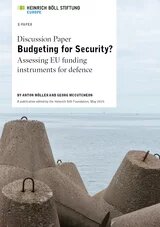
Budgeting for security?

Discussion paper
The ReArm Europe/Readiness 2030 proposal has limited fiscal impact and is unable to address the persistent lack of coordination among Member States, as it does not adequately incentivise joint procurement. Instead, the authors suggest to future-proof the EU's fiscal rules and develop an EU grants-mechanism tied to strategic cooperation, greater parliamentary oversight, and a broader concept of security that includes climate and democratic resilience.
hbs-eu-defence-industrial-policy-cover.png

EU defence industrial policy in a new era

E-paper
The 2024 re-election of Donald Trump as US president, and the realignment of US security strategy that is expected to follow fundamentally changes Europe’s security outlook. The EU cannot become Europe’s security provider, but it can, through its defence industrial policy, support the funding and organization of the rearmament effort.

Shaping the EU's Financial Architecture for the Future

Policy Paper
The European Union faces the enormous challenge of having to achieve the necessary climate targets it has set itself, while at the same time increasing industrial competitiveness and ensuring public services of general interest. A sustainable European financial architecture based on three pillars is needed to finance these green-social investments at EU level. It is presented in this policy paper.